The nursing home pays for drugs during a Part A SNF stay: not Part D, not the family, not Medicaid. The drug cost sits inside Medicare's Part A per-diem payment under consolidated billing, so the facility owes the pharmacy for every drug a covered Part A resident receives. A short list of excluded items is the exception, and the OIG is now reviewing whether facilities meet this duty.
That rule is simple. Applying it every day, across admissions, discharges, leaves and payer changes, is not. When it slips, either the facility pays for drugs it did not owe, a margin problem, or a Part D plan pays for drugs the facility did owe. That is a compliance problem, and the one the HHS Office of Inspector General is looking at now.
What is the rule for drugs during a Part A stay?
Medicare pays a skilled nursing facility a daily rate under the SNF prospective payment system. Under consolidated billing, that rate covers nearly everything a Part A resident receives, including drugs and biologicals the facility ordinarily provides. CMS states it plainly in its SNF Part D fast facts: drugs prescribed for a Part D enrollee are not covered by Part D if Part A or Part B can pay for them. The regulatory basis for consolidated billing sits in 42 CFR 411.15(p).
So for a Part A day, the pharmacy should bill the facility. For a non-Part A day, the pharmacy usually bills the resident's Part D plan, Medicaid, or the resident. For the broader split, see Part A, Part B or Part D: who pays for each drug.
Why is the OIG reviewing SNF drug billing?
In October 2024 the OIG published audit A-09-21-03008. It estimated that Part D's total cost included up to $465.1 million for drugs, from 2018 through 2020, for which payment was available under the Part A SNF benefit. About $245.4 million of that related to drugs that medical records showed were administered to enrollees during their Part A stays.
The audit also found something operators should note. Some drugs given to residents during Part A stays had been supplied by the residents or their families, even though the facility was financially responsible for them.
In April 2025 the OIG added a follow-on project to its Work Plan: SNFs' Financial Responsibility for Drugs for Medicare Part D Enrollees in Part A SNF Stays. The first audit looked at what Part D paid. This one looks at whether facilities met their own obligation, including why some facilities obtained drugs from residents or families. We cover what facilities should prepare for in the OIG's review of SNF drug billing.
CMS responded too. In May 2025 the Medicare Learning Network updated its SNF Billing Reference to address where to send drug claims during short and long stays, as AHCA/NCAL summarized.
The direction is clear. Regulators expect facilities to know, day by day, who should pay for each resident's drugs.
What could your building recover?
Two numbers, instant estimate. No email needed.
Who pays for drugs at admission, discharge and leave?
Most errors happen at the edges of a stay, not in the middle. These are the situations that cause the most confusion.
| Situation | Who generally pays for the drug | What to check |
|---|---|---|
| Covered Part A day | The facility, inside the per diem | No Part D or Medicaid claims for that resident on that date |
| Day of admission to Part A | The facility | Pharmacy's payer flag switched on the admission date, not days later |
| Day of discharge | Ancillaries furnished before discharge are treated as part of the stay's cost (Claims Processing Manual, Ch. 6, §40.3.5) | No separate Part D claim for drugs given that day before discharge |
| Limited take-home supply at discharge | Part A, when medically necessary until a continuing supply is available | Quantity is limited, documented and billed to the facility once |
| Part A benefit exhausted, resident stays | Part D may cover, if the drug is otherwise a Part D drug | Payer flag switched on the right date, so you stop paying |
| Leave of absence, resident not back by midnight | Day is not a covered Part A day | Whether the pharmacy billed you for drugs sent home on leave |
| Medicare Advantage resident | The MA plan's contract with the facility governs | Whether drugs are inside the plan's per diem or carved out |
| Medicaid or private-pay long-stay resident | Medicaid, Part D or the resident, depending on coverage | That none of these drugs landed on the facility's invoice |
| Excluded drugs (for example, certain chemotherapy) | Billed outside the Part A rate under the consolidated billing exclusion lists | That the facility was not billed for an excluded drug |
Two directions of error show up in this table. When a pharmacy keeps billing Part D after a Part A admission, the facility looks cheaper than it is, and the compliance exposure grows quietly. When a pharmacy keeps billing the facility after a Part A stay ends, the facility overpays. Both come from the same root cause: the pharmacy's view of the resident's payer status does not match the facility's census. See also pharmacy charges after discharge, death or leave and consolidated billing exclusions. For long-stay residents, the places those charges still reach the facility are covered in when a nursing home pays for resident medications outside Part A.
Why does the facility carry the risk?
The pharmacy dispenses. The Part D plan pays claims. So why does this land on the operator?
Because the obligation to furnish drugs during a Part A stay belongs to the facility. Federal participation rules at 42 CFR 483.45 require the facility to provide pharmaceutical services. Consolidated billing makes the facility responsible for paying for covered services furnished to a Part A resident, including by outside suppliers. The facility also controls the source of truth for payer status: admission dates, discharge dates, leave dates and Part A benefit days.
If the pharmacy has the wrong dates, it is usually because nobody sent it the right ones, or nobody checked the invoice against them.
How do you keep pharmacy payer status in line with census?
You do not need new software to get this right. You need a reliable loop between census and pharmacy.
- Send payer changes the day they happen. Admissions, discharges, payer switches, leaves and returns. A daily census feed or a same-day email is enough if someone owns it.
- Confirm the pharmacy's payer flag. Ask the pharmacy for a monthly list of residents it has flagged as Part A, with start and end dates. Compare it to your census.
- Reconcile every invoice to census. Each line for a Part A resident should fall inside a Part A date range. Each line billed to you for a non-Part A resident needs an explanation.
- Stop accepting family-supplied drugs as a workaround. If a resident in a Part A stay needs a drug, the facility is responsible for supplying it. The OIG has said it will examine why facilities obtained drugs from residents or families. More in family-supplied medications during a Part A stay.
- Answer Part D plan inquiries promptly. CMS recommends cooperation between facilities and plan sponsors to identify improper Part D payments. Keep the records that show stay dates and administration, and see the Part A drug compliance checklist.
- Document the exceptions. Take-home supplies, excluded drugs and managed care carve-outs should each have a short paper trail.
Free · 48 hours · no integration
Get a free 48-hour pharmacy audit
- Send three files: invoices, census, contract
- See overbilling and Part A exposure, line by line
- BAA signed before any data moves
What does a payer-flag lag cost? An illustrative example
The figures below are illustrative, not drawn from any client or audit.
A 120-bed building averages 18 Part A residents a day. The pharmacy's payer flag lags the census by three days on admissions and four days on Part A endings.
- Admission lag. For three days after each admission, drugs are billed to the resident's Part D plan instead of the facility. Over a year, that is hundreds of resident-days of drugs that Part D may have paid improperly. The facility's pharmacy bill looks lower. Its exposure is higher.
- Ending lag. For four days after each Part A stay ends, the facility keeps paying for drugs that Part D, Medicaid or the resident should have paid. If drug cost runs $40 to $48 per Part A resident-day, the range one SNF operator reported for 2017 and 2018 in Becker's Hospital Review, each lagged day costs roughly that much per resident.
Neither error is visible on the face of the invoice. Both show up immediately when the invoice is matched against census.
What should you ask your pharmacy?
- How do you receive our admissions, discharges and payer changes, and how fast do you apply them?
- Can you send a monthly list of residents you flagged as Part A, with dates?
- How do you handle claims you billed to Part D that later turned out to fall inside a Part A stay?
- How are take-home supplies at discharge billed, and in what quantity?
- How do you identify drugs excluded from consolidated billing?
If the answers are vague, the reconciliation is probably not happening.
Which facilities carry the most exposure?
Exposure scales with Part A volume. A short-stay or rehab-heavy facility carries more Part A resident-days, more admissions and more discharges, so more boundary days where errors occur. An independent nursing home often has one business office person handling census and pharmacy reconciliation alongside everything else, which is where lags creep in.
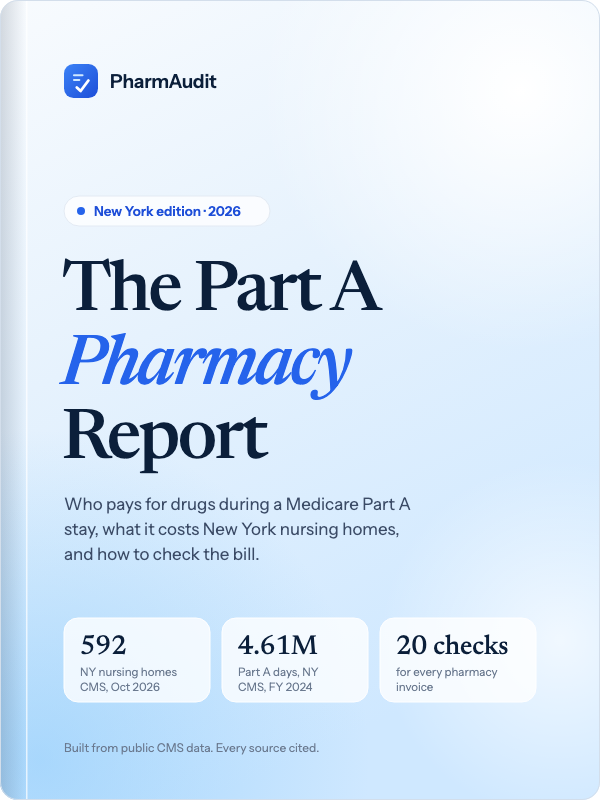 Free report · New York editionThe Part A Pharmacy Report 202620 pages built from public CMS data: Part A days, drug cost estimates, the 20-point invoice checklist.Get the report
This article is general information, not legal advice. Facilities make their own compliance and billing decisions, and should consult counsel on specific situations.
Frequently asked questions
Does Part D ever pay for drugs during a Part A stay?
Not for drugs Part A can pay for. CMS states that drugs prescribed for a Part D enrollee are not covered by Part D if Part A or Part B can pay for them. A small set of items, such as certain chemotherapy drugs, is excluded from consolidated billing and billed outside the Part A rate.
Can a family bring in medications during a Part A stay?
The facility is financially responsible for the drugs a resident needs during a covered Part A stay. The OIG's 2024 audit found that some drugs given during Part A stays had been supplied by residents or families, and its open Work Plan project will examine why facilities obtained them that way.
Who pays for drugs on the day of discharge?
Ancillaries furnished on the day of discharge, before the resident leaves, are treated as part of the stay's cost, so they should not be billed separately to Part D. Part A also covers a limited take-home supply when it is medically necessary until a continuing supply is available.
Get the 48-hour first look
Send us three months of pharmacy invoices, your census and your pharmacy services agreement. Within 48 hours we show you where payer status on the invoice does not match your census, and what that means in dollars and in exposure. A BAA is signed before any data moves. Request your free 48-hour audit, or estimate the dollars first with the savings calculator, which uses our working estimate, not a guarantee.